

Top 5 Videoconferencing & Collaboration Tech Trends Shaping 2026
Share


2025 continued to confirm that hybrid and flexible work models are not a passing fad but a stable part of the working world. According to a 2025 report from Robert Half, 24% of new U.S. job postings in Q2 of 2025 were listed as hybrid and 12% as fully remote, signaling sustained demand for flexibility rather than full returns to office.
At the same time, many employers are re-evaluating their workspace strategies and reintroducing return-to-office (RTO) mandates. This hybrid-plus-RTO environment creates a fragmented workforce, where some people are onsite, some remote, and some rotating between both. That complexity is shared across many organizations which makes robust, flexible collaboration technology more necessary than ever.
With that backdrop, here are five major trends DTEN expect to see in 2026 in video conferencing and collaboration technology.

1. AI Moves from Feature to Foundation
In 2025, AI-enhanced meeting tools like real-time transcription, speaker detection, and automated meeting summaries gained tremendous traction.
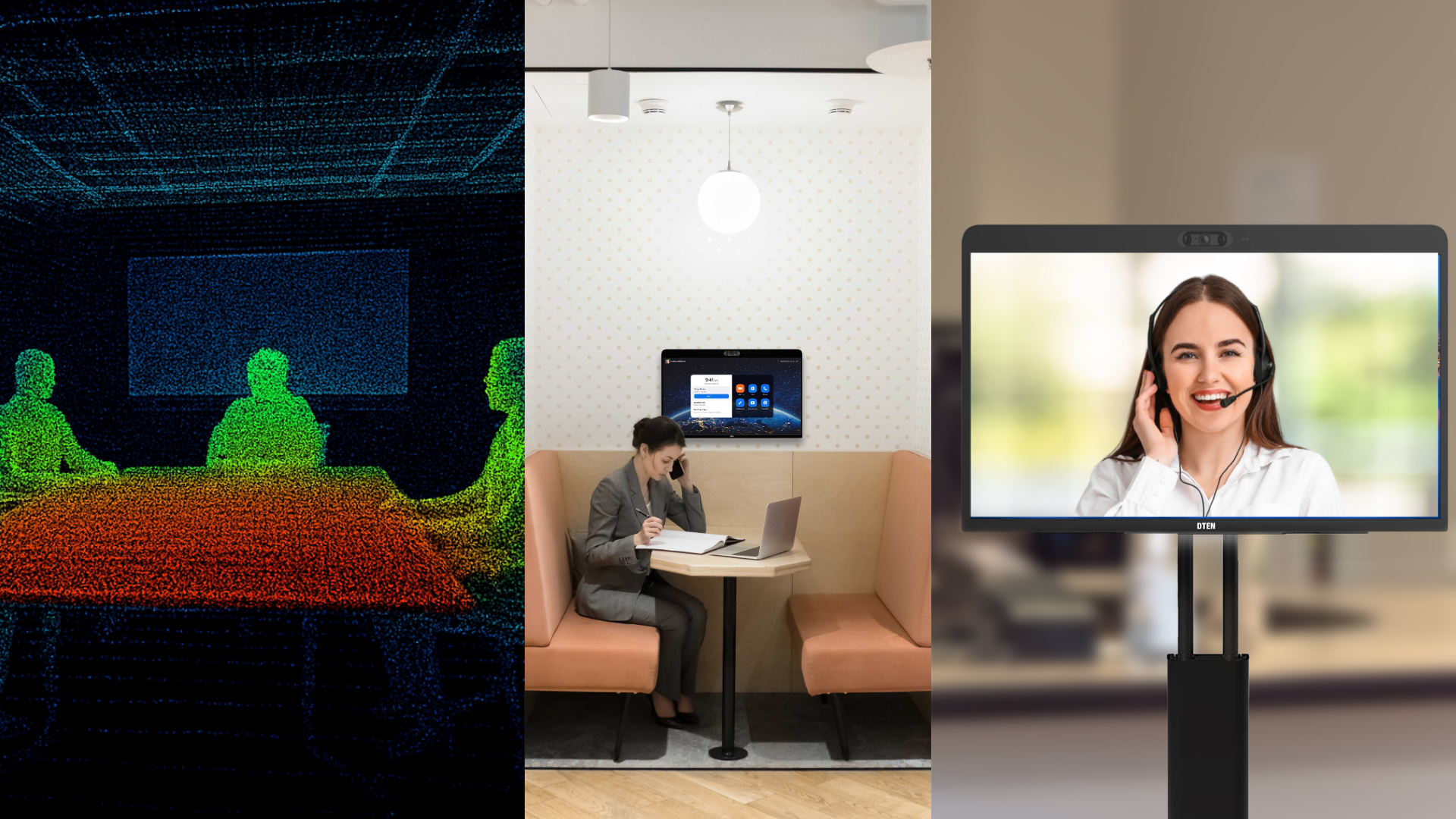
In 2026, this trend will go deeper with AI driving core room functionality.Smarter cameras and spatial-audio systems will enable:
- AI bots and assistants acting as members of a meeting and participating in decision making/research gathering
- Instant name-tagging using facial recognition
- Real-time voice recognition that delivers meeting summaries or action-item lists
- Automatic framing and boundaries with SLAM-based spatial awareness to keep visuals and audio clean
- Superior audio clarity through adaptive beamforming and noise suppression
In a world where participants dial in from varying environments like home offices, huddle rooms or large conference rooms, AI-enabled reliability and inclusivity will be essential.
2. Hybrid Rooms Evolve: Flexible, Cost-Efficient, and Intelligent
2025 saw many employers urging at least partial office presence, especially for collaboration, culture, and oversight. But none of that matters when it comes to connecting with clients, prospects, or partners. Staff WILL be meeting these constituents remotely more often than not, and providing your team with what they need to make those interactions as successful as possible is imperative. What are organizations doing to earn that commute?
That creates a demand for meeting spaces that aren’t rigid or overly engineered but flexible, simple to deploy, and reliable. In 2026, expect room configurations to shift toward:
- Compact, all-in-one boards and video bars or plug-and-play devices rather than bespoke AV installations
- Rooms that automatically adapt, adjusting camera framing, lighting and audio based on number of participants or layout
- Cloud-managed devices that reduce overhead for IT while ensuring consistent performance
This provides organizations with the agility to support varied meeting types without over-investing in infrastructure.
3. Collaboration Tech Penetrates Beyond Conference Rooms
Not all collaboration will happen in formal meeting rooms. Organizations will begin to leverage video conferencing tools across many parts of the workplace:
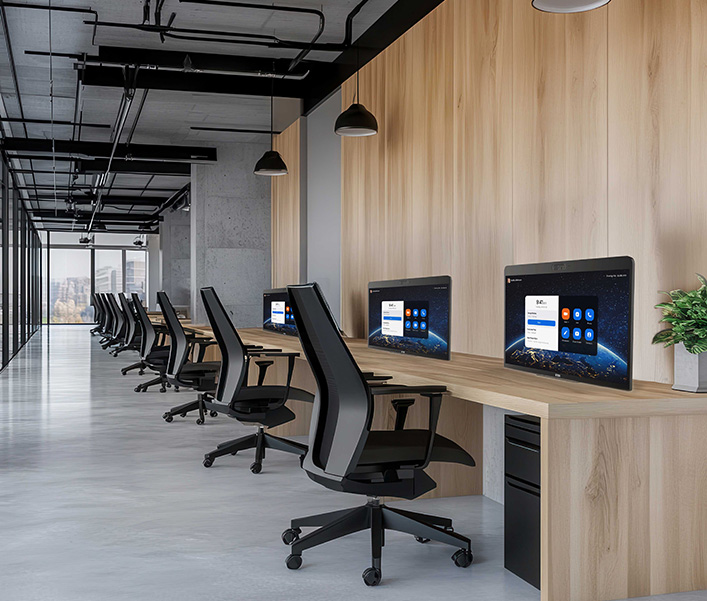
- Hot-desking stations and hotel desks for rotating staff
- Common areas or lounge spaces for informal or creative collaboration
- Training or workshop areas for hybrid learning
- Visitor-facing zones including check-in kiosks, remote-enabled reception desks, or quick remote meetings in transit
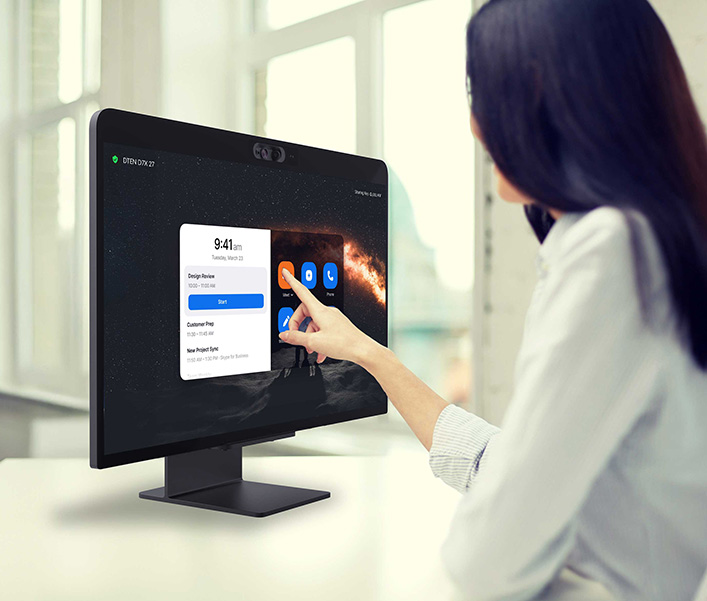
- Touch enable experiences will drive the solutions for RTO 2.0 and beyond
In 2026, expect collaboration hardware and software to transition from “meeting-only” tools to everywhere-collaboration infrastructure reflecting how work itself is distributed and fluid.
4. Audio Quality is Mission Critical…Good Video Isn’t Enough
Unreliable audio remains the biggest pain point in technology-led meetings. Clear video can’t save a meeting where participants struggle to hear each other.
2025 already revealed rising demand for “crystal-clear audio systems” as a core requirement, not a nice-to-have. If a meeting’s video is great but audio isn’t, remote participants tune out.
In 2026, poor audio will not be tolerated, crystal-clear audio is a table stakes baseline. Look for more interest in and investment toward:
- Beamforming microphone arrays that track who’s speaking, even in larger rooms or dynamic layouts
- Smart, adaptive noise suppression and echo cancellation so sounds from hallways or HVAC don’t disrupt conversations
- Audio-over-network or networked-audio systems to support flexible room configurations without sacrificing sound quality
- AI powered tuning in congested spaces
Clear audio is what makes remote participants feel present. In hybrid-heavy organizations, that presence is non-negotiable.
5. Simplicity and User Experience as Key Differentiators
There is a clear expectation that today’s technology will “just work,” and nothing is more frustrating than having a meeting delayed because a speaker won’t connect. Plus, even the most advanced systems fail if users can’t operate them. We have to make it easy for Steve in HR, and Sally in Accounts Payable. They are the users that matter the most.
In 2025, plug-and-play simplicity gained serious traction and that will continue in 2026. Out-of-the-box systems with minimal setup and zero AV-team dependency will gain in popularity thanks to features including:
- One-touch or one-click meeting start; no fiddling with cables, settings, or complex menus
- Seamless “onboarding” experiences for any user whether in a flagship boardroom or a small huddle room
- A focus on meeting equity, ensuring everyone (remote or in-room) has visibility, audio clarity, and intuitive controls.
Because when collaboration tech is easy to use, people actually use it. When it’s complicated, it becomes a barrier. For organizations leading the shift, this spells a mandate: deploy collaboration tech that’s intelligent, flexible, inclusive, and easy to manage.
Why These Trends Matter — And What that Means for Your Strategy
2026 won’t just be about “better video calls.” It will be about frictionless collaboration anywhere, anytime, with anyone.
The biggest winners will prioritize:
- AI-powered inclusivity – Making meetings fair for everyone regardless of location or setup.
- Scalable hardware deployment – Affordability and flexibility for many rooms, not just a few premium ones.
- Audio excellence – Because clear, intelligible communication underpins everything.
- User-friendly experiences – Empowering all users, not just AV-savvy staff.
- Versatile usage – Turning every room, corner, and space into potential collaboration zones.
For teams focused on delivering reliable, high-quality conferencing experiences at scale these trends highlight where to double down.
Final Thought
2026 will be about intelligent, affordable, and widely adopted video conferencing and collaboration technology that doesn’t feel like an IT project. Getting closer and closer to ubiquitous video.
At the end of the day, people want to connect as humans. The solutions that fade into the background and that just works…will win.
Related Posts
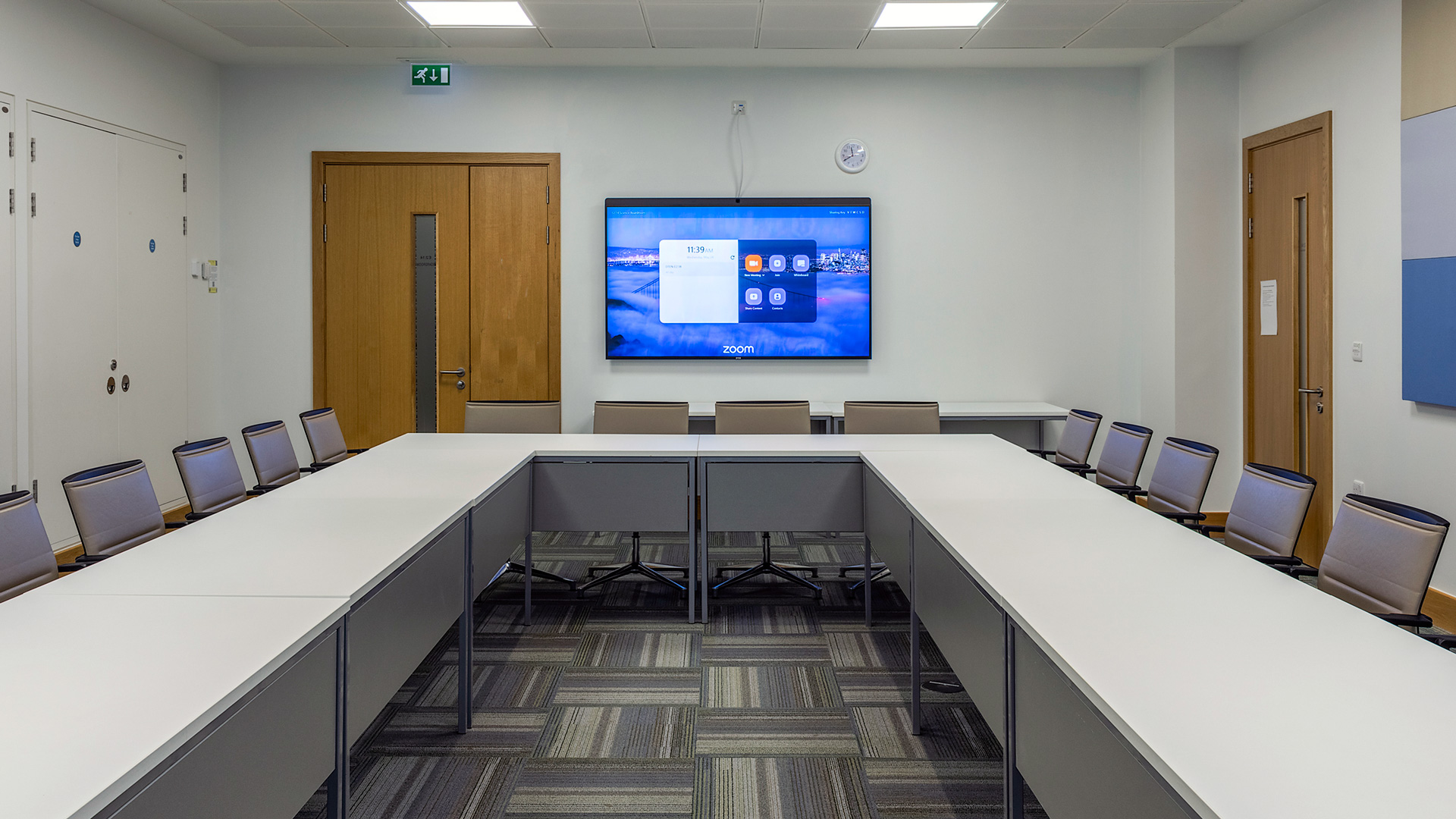
유럽 더블린 대학교(UCD)는 캠퍼스 전체에서 일관된 하이브리드 회의를 위해 DTEN을 표준으로 채택
유럽 더블린 대학교(UCD)는 캠퍼스 전체에서 일관된 하이브리드 회의를 위해 DTEN을 표준으로 채택